
Environmental and marine monitoring
Carried out by the Foundation's team
What does marine environmental monitoring include?
Environmental monitoring measures the same variables, at the same points, with the same method, for long enough that changes mean something. What makes it useful is not the isolated campaign but the series: without a before, there is no way to prove an after.
Who's behind it
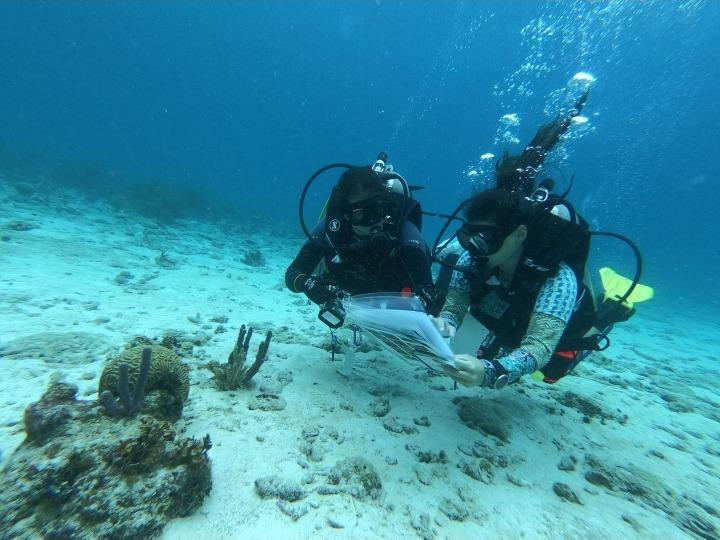
It is the team's deepest line of work: five of seven profiles declare it. It covers phytoplankton analysis with Utermöhl chambers and inverted microscopy, photopigments by spectrophotometry, hydrobiology in lotic, lentic and marine environments, underwater monitoring of coral and seagrass cover, and turtle telemetry. See the team.
What you get
- Report per campaign, with method, results and compared series
- Raw and cleaned database, in open format
- Cartography of the points and of the spatialised results
- Photographic and video record of the transects
- Technical interpretation and alerts when a variable falls out of range
Timeline
Monthly, quarterly or biannual campaigns. The first report is delivered 3 weeks after the campaign.
How we do it
- Water quality: in situ physicochemical parameters and photopigments by ethanol extraction
- Phytoplankton: counts in Utermöhl chambers with inverted microscopy
- Reefs and seagrass: underwater transects and core sampler
- Fish and invertebrates: visual census and morphometric identification (IPez)
- Statistical analysis in R, PRIMER and EstimateS; maps in QGIS and PostGIS
- Remote sensing with Sentinel imagery processed in SNAP
Regulatory framework
- Colombia — Invemar protocols for marine ecosystem monitoring
- Darwin Core standards for publishing biological records
- Resolution 0631 of 2015 where monitoring accompanies a discharge
Request a quote
Tell us about the project, the ecosystem and the timeline. We reply with a scope and an estimate — or we tell you frankly that this is not for us.